
Sustainability, Innovation, and Impact at CIO Association Pune Chapter’s Trailblazing Conference. Tech Saga 2025
Tech Saga 2025, orchestrated by CIO Association Pune Chapter marked a milestone in the evolution of sustainable technology events. In an era where environmental consciousness is more critical than ever, this event set a new standard for what tech gatherings can achieve—combining state-of-the-art innovation with an unwavering commitment to reducing environmental impact.
Inspiring True Carbon Neutrality
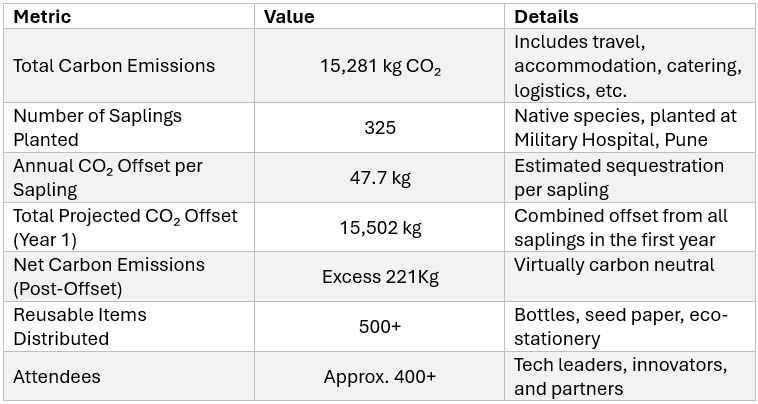
One of the event’s crowning achievements was its thorough, science-based approach to reaching carbon neutrality. Organizers went beyond surface-level gestures and undertook a holistic audit of all carbon emissions sources: travel (for both attendees and speakers), accommodation, food and beverage services, energy usage, logistics and even incidental resource consumption during the event. This comprehensive calculation resulted in a total event footprint of 15,281 kg of CO₂.
To counterbalance this impact, a large-scale tree plantation drive was conducted at the Military Hospital in Pune, where 325 native saplings were planted. Each sapling is expected to sequester 47.7 kg of CO₂ per year, resulting in an impressive offset of 15,264 kg in the first year alone. This left a net balance of positive 221Kg —an extraordinary accomplishment for such a large-scale gathering.
Expanded Sustainability Practices
Tech Saga 2025 showcased a robust suite of sustainable practices, ensuring that every aspect of the event embodied the spirit of environmental responsibility:
- Green Venue Transformation: The event space was adorned with live foliage and gardens, providing not only beauty but also improving indoor air quality and reinforcing the event’s eco-conscious theme.
- Zero-Waste Commitment: Every effort was made to reduce waste generation. Compost bins and recycling stations were strategically placed and event volunteers guided attendees on proper waste segregation.
- Paperless Experience: Registration, schedules and feedback were managed through digital platforms drastically cutting down on paper consumption.
- Locally Sourced & Plant-Based Catering: Menus prioritized locally sourced, organic ingredients and included a variety of plant-based options, reducing food miles and supporting local producers.
- Eco-Friendly Event Materials: All signage, banners, and event materials were printed using biodegradable inks on recycled or reusable substrates, completely avoiding the harmful plastic / flex banners.
- Responsible Gifting: Attendees received sustainable giveaways such as reusable water bottles, seed paper and eco-friendly stationery, discouraging disposable souvenirs.
- Water Conservation: Water stations with reusable cups replaced bottled water, and low-flow fixtures were installed in restrooms to minimize water use.
- Single-Use Plastic Ban: Single-use plastics were strictly prohibited, from food service to packaging and event décor.
- Continuous Awareness: Throughout the event, digital screens and workshops highlighted best practices in sustainability, fostering a culture of environmental stewardship among all participants.
Key Metrics: Summary Table
Legacy and Future Impact
Tech Saga 2025 has set a bold example for the industry—proving that large tech conferences can be both high-impact and environmentally responsible. The integration of comprehensive green practices, paired with quantifiable carbon offsetting, has inspired a new paradigm for event sustainability.
Looking ahead, this event’s blueprint will undoubtedly influence future gatherings across industries. Its legacy lies not only in technological advancement but also in demonstrating that progress and planetary stewardship can go hand in hand. Tech Saga 2025 stands as a testament to what is possible when innovation meets intention, paving the way for a more sustainable future in the tech world and beyond.
The CIO Association is deeply committed to sustainability and has introduced a Special Interest Group (SIG) to carry this mission forward. This SIG will focus on driving eco-friendly initiatives across its 16 Chapters and ensuring that sustainability remains at the forefront of all future events.